Author: tiphane

More Thoughts about Creativity and Human-Centered Design

I wrote last week about Richard I. Anderson‘s class on User-Centered Design and Usability, and more thoughts occurred to me about how I found myself advocating for more user involvement in all phases of design and engineering while in fact I wanted to free my creative spirit. I am retired, and I have happily tried various creative endeavors: writing short stories and poetry, playing the piano, taking photos, sewing, dancing, etc. I remember my best moments in my early days at work were when I could write a piece of code that was, mostly, a beautiful piece of code, or finding my way out of someone else’s spaghetti code… Talking to people – users or others with alternative ideas – was hard, because they were challenging my creation. Of course, that doesn’t work well in product development, but everyone was doing it, from marketers to designers to the facility manager who had chosen the color of the walls. It has gotten worse recently with random commenters on the web. I have stopped altogether looking at …

In Memoriam: Richard I Anderson

Recently I was showing a usability issue of the institutional kind to a friend, and mentioned I had learned so much about human-centered design from taking Richard I. Anderson’s class, oh some 30 years ago maybe? So I wanted to check on Richard and stumbled upon the announcement of his passing and a memorial at BayCHI, an organization he gave so much of his time and energy. I retired early, and learned about Richard’s sickness and times of homelessness, contributed to “Friends of Richard,” and I think last time I met him at a cafe in Berkeley he was going to shelter at a friend’s house (I learned at the memorial it did happen). There was no reason for me to not believe his story and discovery of the sickness he had been afflicted with, but I was so sorry that he had relied on friends who sent him on a spiraling downfall by having him committed to a mental ward. I read his now deleted blog telling how after he had recovered (thanks to …

1978-1981: from Sherbrooke to Switzerland

I found this job at the computer centre of the Université de Sherbrooke, having responded to an ad in the newspaper La Presse. It wasn’t quite “in my field” if there was such a thing after the experience of developing COMPO and the map-making software, and I found that the best part of it was the few hours a week I had to be at the “consulting desk” solving people’s problems. This was an IBM 360 installation, and even that was relatively new to me, but in a sense it was all about trying to figure out what they were trying to do, and find in the manuals the description of their instructions. I even learned basic computer operations, mounting magnetic tapes and disk packs, so it was fun to be around. In the late spring, the director of the Math department came to ask if I could teach a summer class to substitute a professor suddenly unable to do it. I had given them a seminar on the Pascal language, and the class was …

1978: COMPO, a Phototypesetting System

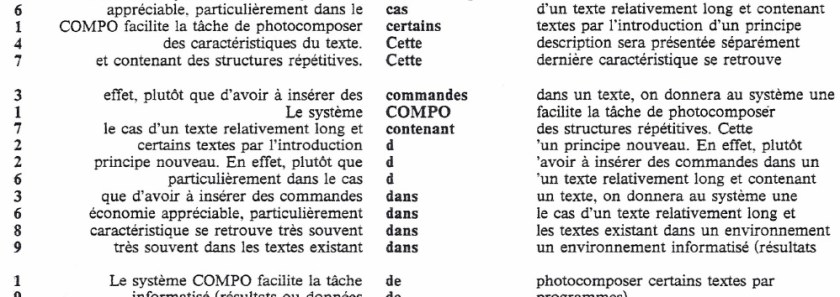
That was the title of my Master’s Thesis. It was written in French, at the Université de Montréal. It’s on microfilm at the University’s library (I’m not sure if I kept a copy, in all my moves!). Here’s a paper I wrote in French about it, in which you can see examples of what it did: My advisor hadn’t been too pushy or specific about what to do, and he was going to spend the year away on sabbatical… I guess that was a good way to let me be creative, even though I didn’t know that word at the time. Self-expression, self-determination, and even self-esteem weren’t part of my upbringing, and I had been told to be quiet early on as a child. But I had chosen this advisor, Paul Bratley, at first because in a presentation of the department’s professors, he had the most interesting field of interest. I shyly knocked on his door, intimidated by his look (what was it? His facial expression said I could be boring), and said I found …

The End of Year Tote Bags

Made of fabrics that were left from other projects… Many odd shapes that I cut and put together in a mosaic… The interfacing layer that makes the sides more rigid also adds to the solidity of the mosaic (considering also that those are different fabric types). This was a fun project! Both bags have a stiffer bottom made of the twill fabric with a thick canvas. The same twill fabric is used for the lining (inside the bag, and inside each pocket), and the handles (sewn around layers of canvas or other hard material).