All posts filed under: Non-Fiction

musique et poésie (1)

I’m starting this series today because I heard some learners of French were sharing poetry, and I keep a playlist of songs from mostly 50 years ago that I listened to back then, when I was young! 1- Les Feuilles Mortes This is a well-known song and poem by Jacques Prévert that you’ll hear translated as Autumn Leaves, however the translation leaves a whole lot of it out. So get the one sung by Yves Montand (French actor whom I remember from movies like César et Rosalie and Z). I don’t know if this link will work for Apple Music: https://music.apple.com/us/song/les-feuilles-mortes/1444874656 It was also sung by Juliette Greco, Edith Piaf, and many others. It’s a song about remembering happy days spent together on the sea shore (“et la mer efface sur le sable, les pas des amants désunis”), the fallen leaves an image for thoughts, feelings and remembrances that have since died out and that the cool wind from the north blows away. Or something like that… 2- Je t’aime, moi non plus This one …

Do Me a Favor and State Your Pronouns

In the space of the first two weeks of the Trump regime, they have managed to eliminate DEI not only across government agencies, but also on corporations. Any mention of the existence of trans and non-binary people have been removed from official documents, and everyone was surprised to see LGBTQI+ suddenly was truncated to LGB (hint: some wealthy donors are gay). We ceased to exist. I’m not too worried… They’re wrecking so much that they are going to provoke much bigger crises. I’m actually relieved that they’re erasing us, it won’t be on the minds of tourists improvising as gender police. It was thanks to DEI trainings that I started using They/Them or She/Her pronouns (this regime also put an end to all DEI efforts and even blame DEI for causing plane collisions – it’s code for saying they only want white men everywhere, preferably the ones without a fully developed frontal lobe, but I digress). I don’t say “She/Her” alone, because in reality I am afraid of a backlash. I concede that I make …

DYI User-Centered Design and Usability

Too late in my working life to have any effect on my work, I took a class from Richard I Anderson, a survey of user-centered design and usability research, which at the time were relatively new. Designers were relying on their own instincts or copying from others who dominated the market, and more often than not Computer Science curriculum never included the possibility that we were making our users’ lives more difficult by imposing our views on them of how they should interact with our creations. To make matters worse, our employers insulated departments from each other, and conflicts would arise about “who owns the user.” Was it the industrial designer, hired by Marketeers to entice consumers to buy the product, or the Engineer who applied their techniques to the best of their knowledge? I was neither of them, relying mostly on intuition (not really great either), and never being able to impose my views (I came to specialize in fixing other people’s software because I could take it home and rewrite it with clarity, …

My Father’s Camera: an Experiment

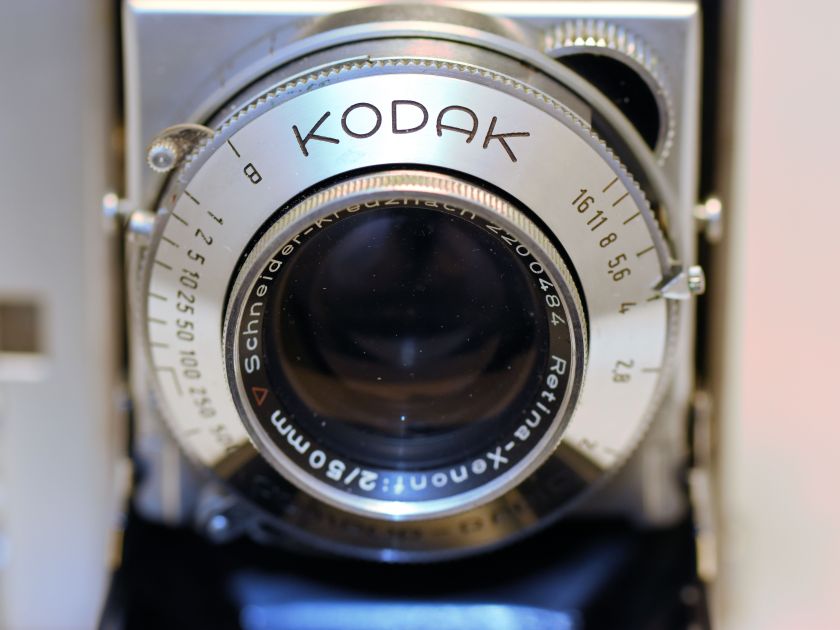
I recently revived my father’s camera, a Kodak Retina II from the 1940’s, as I described in this earlier post. I am fortunate enough to have a local photo shop, called Looking Glass, within biking distance, where I could buy a roll of film. There were very few options, and I was surprised that the Kodak brand still existed. I also saw from the shop’s web site that some films were subject to quotas! I went home with Kodak Ultramax 400 film of 36 exposures. The 400 ASA number felt very high as I remembered using 100 ASA negative films and Kodachrome 64 and 25 for slides. 400 meant I could take photos in lower light conditions, faster speeds, and/or smaller apertures. It was appropriate that I would use Kodak film in a Kodak camera… I found an image of the original user’s manual (from retinarescue.com) which suggested that of course. The user’s manual shows distance settings in Feet, whereas my father’s model shows them in Meters, a sign to me it had been manufactured in Germany for the European market (and may …

50 ans d’informatique: #3 des exemples

Des exemples de problèmes d’usabilité On en rencontre tous les jours, et ce sont souvent des problèmes qui ne sont pas informatique. Combien de fois j’ai pris un raccourci à travers un gazon en marchant! J’ai pensé ici mentionner des situations multi-départementales pour illustrer comment ce n’est pas seulement la tâche des concepteurs. La carte Opus dans la région de Montréal J’ai grandi à Laval (en fait c’était Duvernay sur l’île Jésus, fusionnée avec 13 autres villages), et comme vous le savez, il y a une agence de transport différente de celle de Montréal. Ce qui faisait que nous prenions la CTL (après l’autobus Provincial) avec sa tarification séparée, puis la STM (la CTM, la CTCUM), et le métro. Pour se rendre à l’université on prenait la 28 de la CTL pour aller au métro Henri-Bourassa, puis l’autobus 51 à Laurier. Dans le bon vieux temps, on pouvait obtenir de la monnaie directement du chauffeur (il n’y avait que des chauffeurs mâles). On apprenait les horaires ainsi que ceux des alternatives quand on manquait notre …

50 ans d’informatique: #2 – méfiez-vous de l’autorité

numéro 2 de ma série 50 ans d’informatique Dès les premiers jours du MacIntosh de Apple, il y avait un engoument autour de cette machine de la même façon qu’auourd’hui il y a un certain engoument pour le iPhone en comparaison des autres. À l’époque, l’enthousiasme était lié à la facilité d’utilisation, ce qui était indéniable en comparaison aux complications d’installer différents logiciels sur un PC, en plus des équipements, mais après quelques années les arguments des adeptes du Mac perdaient de leur sens, et ressemblaient plus à de la religion. Je travaillais sur des produits pour le PC et Windows, et je me souviens avoir discuté les mérites de mettre du texte en dessous des icônes pour accélérer la reconnaissance et l’efficacité du travail de l’usager. Je trouvais personnellement de la difficulté à distinguer certains icônes des autres, et la culture du département d’engineering disait que j’étais un minable usager. Sauf que quelques années plus tard, une nouvelle version de Windows (je crois que c’était 95) montrait les icônes avec un nom en dessous …

50 Ans d’Informatique: Se Centrer sur l’Usager

Il y a 50 ans déjà, je commençais au département d’informatique de l’université de Montréal… Il y a 42 ans, j’écrivais un document préliminaire au projet qui allait financer les activités fondatrices de Logitech. Depuis longtemps à la retraite, j’ai passé à d’autres choses (par exemple, j’ai fait un M.A. en litérature anglaise), mais j’ai toujours gardé l’oeil pour un domaine qui n’est toujours pas enseigné en informatique: la usability et le user-centered design. Je voudrais simplement montrer des exemples, dans cet article et ceux qui suivront, de comment nous devrions, en tant qu’auteurs, designers, développeurs, et membres d’équipes de développement de produits, aller voir comment le vrai monde utilise nos produits, ou les produits des autres, ou travaille dans le domaine d’une application que l’on voudrait qu’elles adoptent. Idée #1: Vous ne savez pas tout, et votre équipe non plus Je me souviens de mon mémoire de maîtrise qui était centré autour d’un logiciel que j’avais écrit pour transformer des textes afin de les envoyer à un appareil de photocomposition. J’avais inventé un langage …

More Thoughts about Creativity and Human-Centered Design

I wrote last week about Richard I. Anderson‘s class on User-Centered Design and Usability, and more thoughts occurred to me about how I found myself advocating for more user involvement in all phases of design and engineering while in fact I wanted to free my creative spirit. I am retired, and I have happily tried various creative endeavors: writing short stories and poetry, playing the piano, taking photos, sewing, dancing, etc. I remember my best moments in my early days at work were when I could write a piece of code that was, mostly, a beautiful piece of code, or finding my way out of someone else’s spaghetti code… Talking to people – users or others with alternative ideas – was hard, because they were challenging my creation. Of course, that doesn’t work well in product development, but everyone was doing it, from marketers to designers to the facility manager who had chosen the color of the walls. It has gotten worse recently with random commenters on the web. I have stopped altogether looking at …

In Memoriam: Richard I Anderson

Recently I was showing a usability issue of the institutional kind to a friend, and mentioned I had learned so much about human-centered design from taking Richard I. Anderson’s class, oh some 30 years ago maybe? So I wanted to check on Richard and stumbled upon the announcement of his passing and a memorial at BayCHI, an organization he gave so much of his time and energy. I retired early, and learned about Richard’s sickness and times of homelessness, contributed to “Friends of Richard,” and I think last time I met him at a cafe in Berkeley he was going to shelter at a friend’s house (I learned at the memorial it did happen). There was no reason for me to not believe his story and discovery of the sickness he had been afflicted with, but I was so sorry that he had relied on friends who sent him on a spiraling downfall by having him committed to a mental ward. I read his now deleted blog telling how after he had recovered (thanks to …